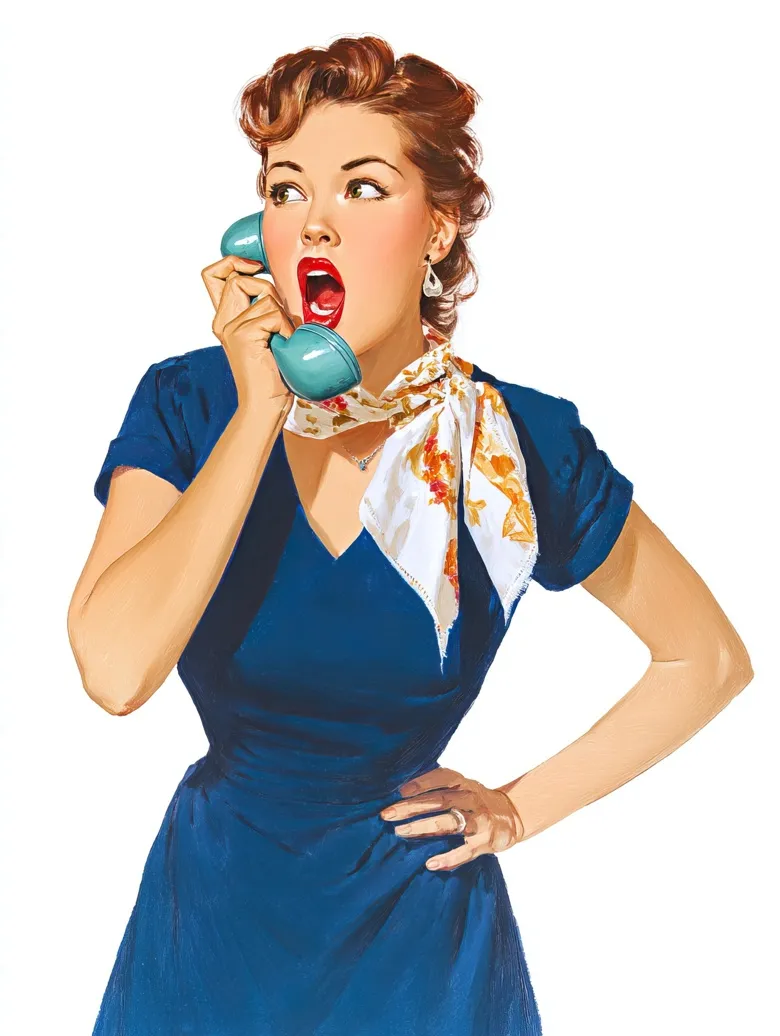
Glamour Is Back and It's Angry: How Pin-Up Aesthetics Are Rewriting the Beauty Rulebook

Photo: vintage 1950s glamour makeup red lipstick retro beauty portrait dramatic, via www.girlversusdough.com
Scroll through Instagram or TikTok on any given afternoon and you'll notice two very different beauty universes coexisting in uneasy tension. On one side: the dewy, understated, "I woke up like this" aesthetic that has dominated mainstream beauty culture for the better part of a decade. Skin-tinted serums. Brow lamination. The studied appearance of not trying.
On the other side: something older, louder, and increasingly defiant. Full coverage foundation. Dramatically arched brows. Victory rolls. A lip so red it practically announces itself before you walk into the room.
The pin-up revival is real, it's growing, and if you think it's just a costume trend, you're missing the point entirely.
The "Clean Girl" Backlash No One Saw Coming
To understand why the pin-up aesthetic is resonating so deeply right now, you have to understand what it's reacting against. The so-called "clean girl" look — popularized around 2021 and still going strong — prizes effortlessness above all else. Slicked hair, minimal color, glassy skin. The implicit message: real beauty doesn't look like it's trying.
It sounds liberating. In practice, critics argue, it's anything but. Achieving the "effortless" look often requires significant time, money, and a very specific set of genetic starting points. The naturalness is, paradoxically, intensely constructed. And for women whose features don't naturally align with the aesthetic — fuller faces, deeper skin tones, stronger brows — it can quietly communicate that their version of beauty requires editing down rather than amplifying up.
Enter the pin-up revival as a form of aesthetic rebellion. Where "clean girl" says less, pin-up says more — intentionally, unapologetically, and with full awareness of what it's doing.
"There's something genuinely radical about putting on a full face of vintage-style makeup in 2024," says beauty content creator and retro enthusiast Delia Marsh, who runs a popular platform dedicated to mid-century makeup techniques. "It says I'm not trying to look like I'm not wearing makeup. I'm wearing makeup. On purpose. Because I wanted to."
The Psychology of Theatrical Femininity
Beauty historians have a term for what's happening: the pendulum swing. Every generation of beauty culture eventually pushes hard against the one that preceded it. The maximalism of the 1980s gave way to '90s minimalism. The hyper-glam of early 2000s celebrity culture softened into the no-makeup movement of the 2010s. And now, predictably, the pendulum is swinging back.
But this particular swing carries something extra. It's not just aesthetic preference — it's identity politics.
Dr. Renata Voss, a cultural historian who specializes in American femininity and visual culture, describes the current pin-up revival as "a reclamation project." In her view, younger women are gravitating toward theatrical femininity precisely because it has historically been dismissed. "There's been a long cultural narrative that serious women don't wear too much makeup, don't dress too provocatively, don't perform femininity too loudly," she explains. "Choosing to do all of those things, deliberately and joyfully, is a way of rejecting that hierarchy."
This is a crucial distinction. The women driving the modern pin-up revival aren't simply nostalgic for the 1950s — many are deeply aware of the era's limitations and contradictions. They're not reclaiming the submissiveness sometimes associated with that period's femininity. They're reclaiming the visual language of it: the color, the drama, the unapologetic celebration of the body.
Pin-Up Meets Body Positivity: A Natural Alliance
One of the most interesting intersections in the modern pin-up revival is its relationship with the body positivity movement. On the surface, it might seem like an awkward pairing — classic pin-up imagery was often tied to a very specific, idealized body type. But the contemporary version of this aesthetic has actively worked to expand that frame.
Influencers and performers across the country are reinterpreting pin-up iconography through bodies that would never have appeared in the original Betty Grable-era imagery. Plus-size burlesque performers, disabled models in retro swimwear, non-binary artists in full vintage glam — all are claiming space within an aesthetic that was originally far more narrow.
"The original pin-up was about celebrating the female form, full stop," says Roxanne Castillo, a Texas-based burlesque performer and vintage fashion advocate. "We're just expanding the definition of what 'the female form' looks like. All of it deserves to be celebrated with this much glamour."
That expansion is part of what's made the aesthetic so sticky with Gen Z in particular. A generation that has grown up with extensive conversations about representation finds something genuinely appealing about an aesthetic that, in its modern iteration, is actively trying to include everyone.
From Streaming Screens to Social Media: Where the Icons Come From Now
Classic pin-up culture had its icons — Marilyn Monroe, Bettie Page, Jane Russell, Ava Gardner. Women whose images were reproduced on everything from nose art to magazine covers. The modern revival has its own constellation of influences, and they live primarily on screens rather than in print.
Streaming has played a significant role. Shows with strong vintage aesthetics — think anything set in the mid-century period with a focus on female characters — have introduced the visual language of the era to audiences who might never have sought it out deliberately. Costumes that feature structured silhouettes, bold color blocking, and dramatic makeup have sparked genuine style conversations online, driving viewers to search out the real-thing vintage references behind the productions.
On social media, the pin-up revival has found its most energetic home on TikTok, where creators documenting vintage makeup transformations routinely rack up millions of views. The before-and-after format is perfectly suited to the dramatic nature of the aesthetic — the contrast between a bare face and a fully realized 1950s glamour look is visually arresting in a way that a subtle "clean girl" transformation simply isn't.
The Lipstick as Statement
If there's one single object that has become the symbol of this aesthetic moment, it's the red lipstick. Not a lip stain, not a tinted balm — a full, opaque, classic red lip, applied with intention and worn without apology.
Beauty brands have noticed. After years of marketing that emphasized natural tones and "your lips but better" formulas, there's been a measurable uptick in the marketing of bold, vintage-inspired lip colors. The language has shifted too — less "effortless" and more "powerful," less "subtle" and more "iconic."
It's a small thing, a tube of lipstick. But in the context of a broader cultural moment where theatrical femininity is being actively reclaimed as an act of self-determination rather than performance for others, it carries a lot of weight.
The pin-up aesthetic has always been about visibility — about saying I am here, I take up space, and I look exactly the way I chose to look. In an era that has spent years telling women that the most sophisticated thing they can do is look like they're not wearing any makeup at all, that message lands differently. It lands like a declaration.
And honestly? It looks incredible doing it.