Ruffles, Rebellion, and Reclamation: How Vintage Fashion Became a Radical Act of Self-Ownership
Let's get one thing straight right out of the gate: nobody handed pin-up culture to women as a gift. The original 1940s and '50s pin-up imagery was produced almost entirely by men, for men, plastered across military barracks and garage calendars as a kind of visual shorthand for what a "desirable woman" was supposed to look like. Tiny waist, big smile, cheerful expression — always available, never complicated.
So how on earth did that become a feminist statement?
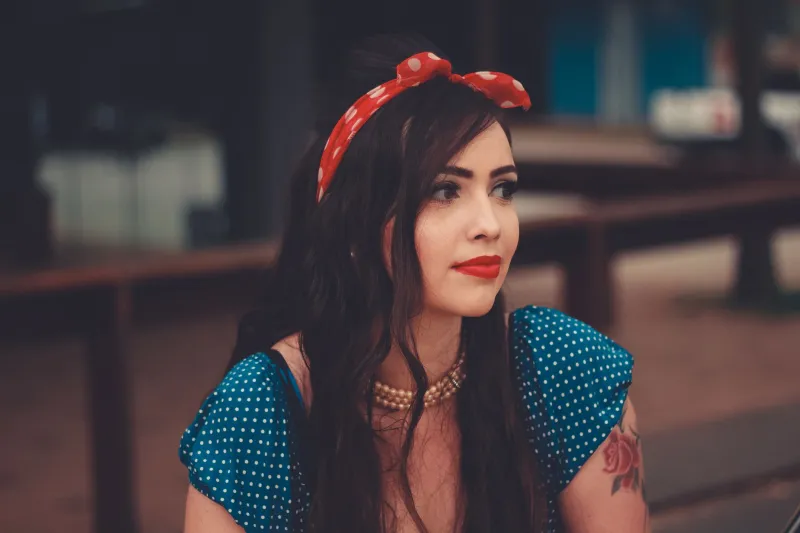
Ask any woman who's spent a Saturday morning pinning victory rolls into her hair, and she'll probably laugh at the question. Because to her, the answer is obvious. She didn't put on that polka-dot swing dress to please anyone. She put it on because it made her feel like the most powerful version of herself. And that distinction — who the look is for — changes absolutely everything.
The Original Paradox Nobody Talked About
Here's the thing historians love to point out: even in its earliest incarnation, the pin-up aesthetic was never quite as simple as "passive woman, appreciative man." The women who modeled for artists like Alberto Vargas and Gil Elvgren weren't shrinking violets. Many were working professionals — dancers, actresses, models — who negotiated their own contracts and understood exactly how their image was being used.
Dr. Maria Buszek, author of Pin-Up Grrrls: Feminism, Sexuality, Popular Culture, has argued for years that the pin-up was always a more complicated figure than her cheerful surface suggested. She embodied a kind of aspirational femininity that was simultaneously constrained by postwar gender expectations and quietly transgressive within them. A woman who was confident in her body, comfortable with her sexuality, and entirely aware that she was being looked at — that's not a passive figure. That's a woman who knows how to work a room.
Fast-forward to today, and that complexity has only deepened.
Choosing the Look Changes the Look
When contemporary women reach for a circle skirt or a pair of seamed stockings, they're doing something the original pin-up models never quite got to do: opting in with full knowledge of the history attached to that choice. And that voluntary quality is, according to many enthusiasts, the whole point.
Take someone like Rosalie Fontaine, a burlesque performer based out of New Orleans who has been working the vintage aesthetic professionally for over a decade. "People always want to ask me if I feel exploited," she says. "And I have to explain that exploitation requires someone else holding the power. When I'm the one deciding what I wear, what I show, what I charge for a ticket — that's not exploitation. That's a business."
Rosalie's perspective echoes what you hear from vintage enthusiasts across the country, whether they're performing on stage or just hitting up a Sunday flea market in a fit-and-flare dress. The act of choosing vintage — with awareness of its origins, its baggage, and its complicated history — transforms it from a relic of constraint into something closer to a costume of confidence.
The Body Politics of a Petticoat
One of the most quietly radical things about modern pin-up culture is how thoroughly it has dismantled mid-century beauty standards — even while borrowing their wardrobe.
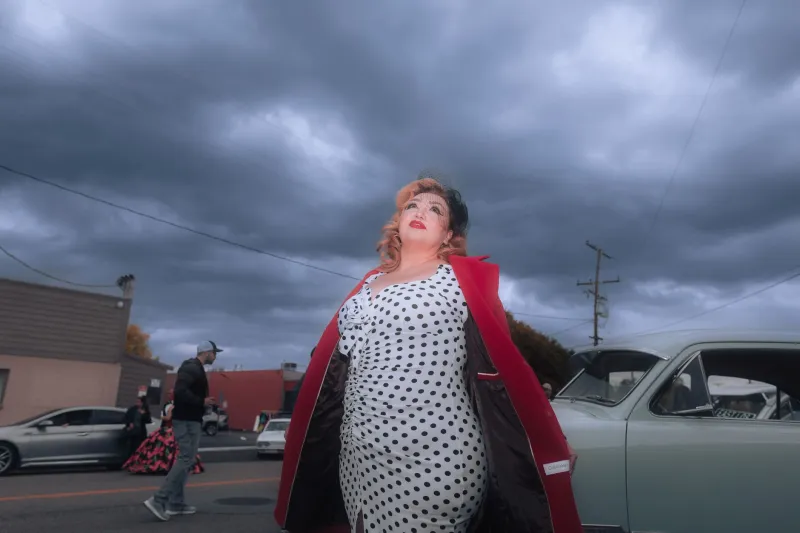
The 1950s pin-up had a very specific body type in the cultural imagination: hourglass, white, able-bodied, conventionally pretty. Today's pin-up community looks nothing like that. Women of every size, skin tone, age, and ability are claiming the aesthetic and making it their own, often explicitly as a response to being told by mainstream fashion that their bodies aren't "right" for certain looks.
Blogger and vintage stylist Deja Monroe, who runs a popular Instagram account dedicated to plus-size vintage styling in Atlanta, puts it plainly: "Every time I post a photo in a swing dress with my arms out and my belly showing and I'm grinning at the camera, I'm telling every girl who looks like me that she gets to feel like this too. That's not submission. That's a declaration."
There's something almost defiant about the way modern pin-up women occupy space in their clothing. The exaggerated silhouettes — full skirts, structured bodices, nipped waists — don't minimize the body. They announce it. And when women of all shapes and sizes step into those silhouettes with joy rather than apology, the whole framework of who the look was "designed for" collapses entirely.
Vintage as Visual Language
For a lot of women, choosing pin-up fashion isn't just about aesthetics — it's about communication. In a culture where women's clothing choices are still relentlessly scrutinized and assigned meaning by outside observers, wearing something this deliberate and this loaded with history becomes a way of seizing control of your own narrative.
"I wear vintage because it's loud," says Tamsin Wheeler, a librarian in Portland, Oregon, who wears 1950s-inspired clothing to work every single day. "People can't ignore me. They have to see me. And I get to decide what they see."
That visibility is a recurring theme. In a world that has spent decades telling women to shrink — smaller clothes, quieter voices, fewer opinions — there is something genuinely subversive about choosing a fashion vocabulary that takes up space. Polka dots don't whisper. Petticoats don't apologize. Red lips don't ask permission.
The Conversation Isn't Over — And That's the Point
It would be too easy to wrap this up with a tidy bow and declare pin-up fashion officially, unambiguously feminist. The truth is messier and more interesting than that. There are still real conversations happening within vintage communities about representation, about the male gaze, about whether reclaiming an aesthetic ever fully neutralizes its original intent. Those conversations are healthy. They're necessary. And the fact that they're happening at all is proof that this community is doing something more than just playing dress-up.
Because here's what the women rocking petticoats in 2025 understand that the calendar-makers of 1952 never anticipated: when you give women a look and then women take that look and make it entirely their own, the look doesn't belong to you anymore.
It belongs to them.
And darling, they are wearing it beautifully.